


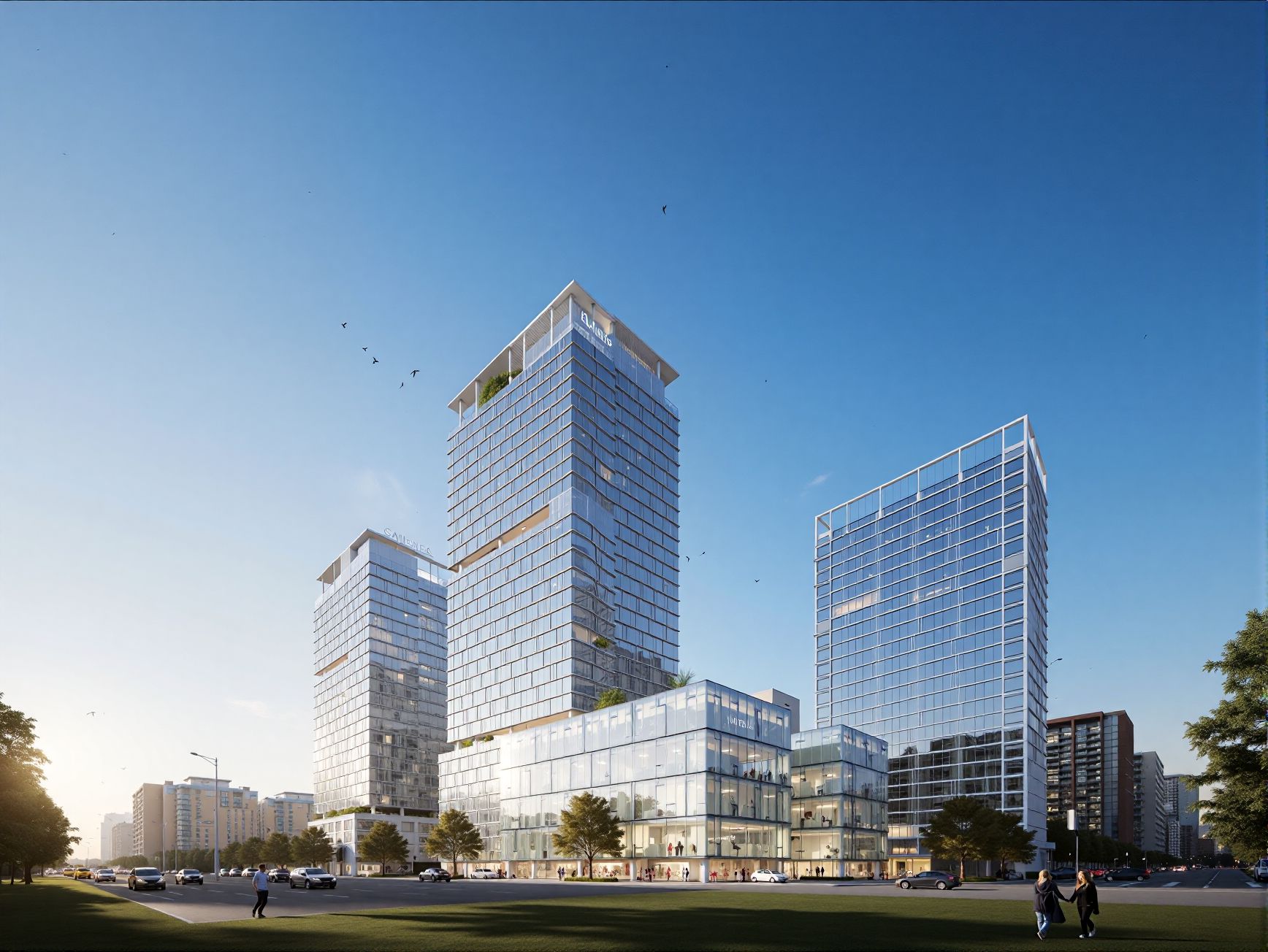
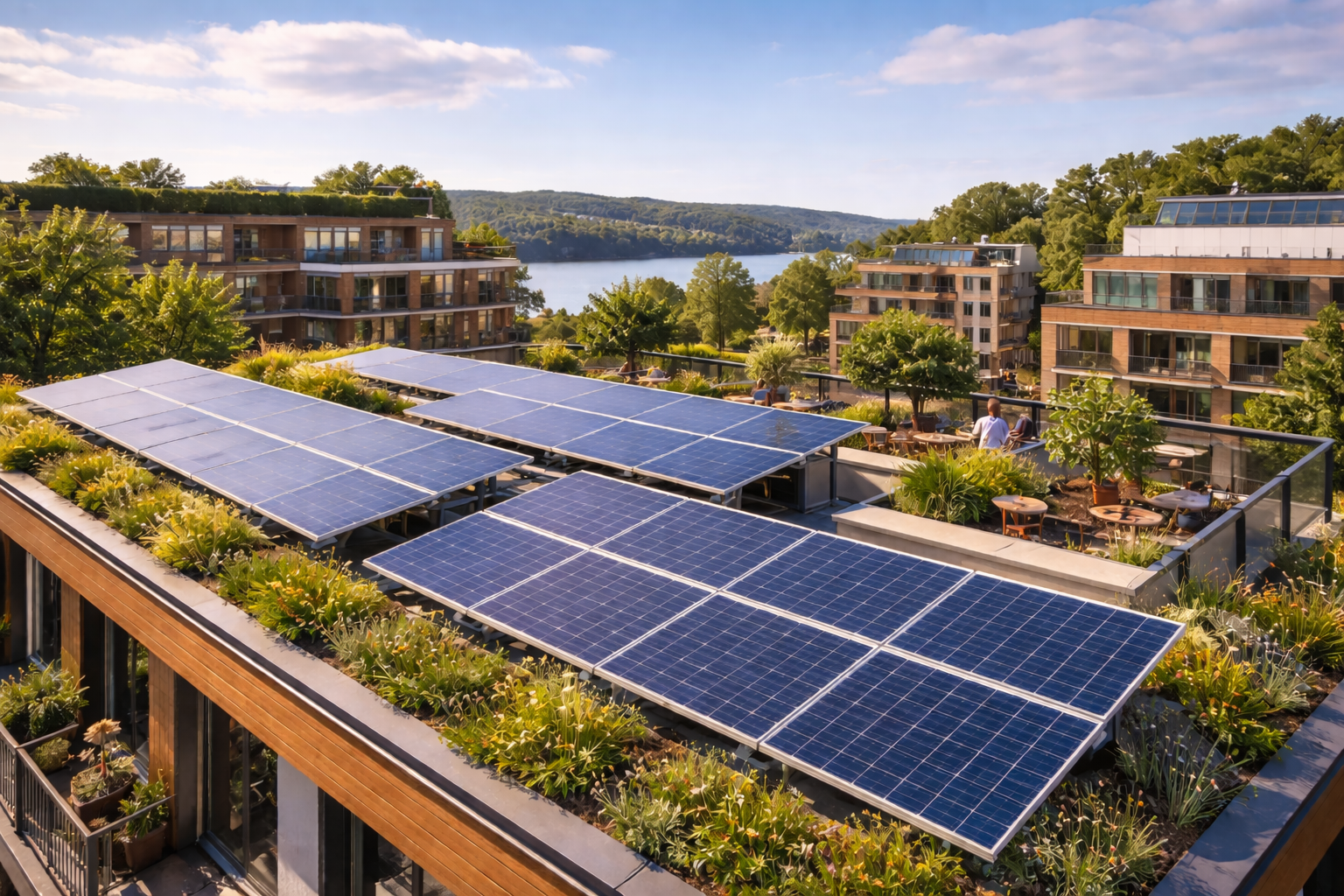


EdenRise Group doesn’t just construct buildings.
We build climate statements backed by numbers.
By combining MagicSteel, design for disassembly, an industrialised supply chain, flexible architecture and digital twins, every project can be tracked, compared and optimised from the first steel profile to the last kilowatt-hour.
Lifecycle analyses show that EdenRise can cut embodied emissions by up to around 50% compared to traditional concrete frames when low-CO2 material choices are combined with design for disassembly and reuse.
That means fewer tonnes of CO2e per square metre – not just “green messaging”. At the same time, our building envelopes and glazing solutions can deliver 25–40% lower energy use and U-values approaching well-insulated exterior walls, with more daylight, slimmer frames and higher perceived quality for residents.

Through advanced vacuum glazing and integrated curtain/shutter solutions, we can reach U-values down towards ~0.40 W/m²K for the glazing itself and, when combined with insulating curtain solutions, theoretical levels around ≈0.24 W/m²K – comparable to well-insulated exterior walls.
Energy performance reports from EdenRise housing projects indicate EP values around 30–45 kWh/m²/year, depending on height and orientation 25–40% lower energy use than traditional reference buildings.
In regular construction, up to 50% of the heat can escape through the glass. With EdenRise, the façade can become one of the strongest energy assets. Detailed energy optimisation belongs in the EdenRise Energy section, but from an ESG perspective the message is clear: lower embodied emissions + lower operational energy.
read moreComparative analyses against tilt-up concrete show that EdenRise achieves roughly 15–20% lower A1–A5 emissions already in standard scenarios and can reduce emissions further with low-CO2 material choices and in DfD (design for disassembly) + JIT (just-in-time) scenarios, total embodied emissions can be brought down to around 230 kg CO2e/m² GFA, compared to about 480 kg CO2e/m² GFA for conventional concrete solutions.
These levels support high climate ambitions, whether the target is national climate declarations, EU taxonomy alignment or international certification frameworks.
Key environmental points:
- Significantly lower emissions per m² GFA than tilt-up concrete in A1–A5
- Additional reductions through reuse credits (Module D) for steel structures and panels
- Industrialised logistics (JIT) reduce transport, waste and site-related emissions
The steel structure is assembled with bolted connections, not permanent cast-in-place solutions.
Building envelopes and internal walls are panelised, enabling removal, refurbishment and reuse.
The DfD+JIT strategy ensures that material flows, assembly and future disassembly are all planned in the design phase.
In practice, this means that large parts of the structure can be removed and reused in new projects, rather than ending up as crushed rubble or landfill. In our DfD scenarios, reuse credits significantly reduce the effective climate footprint.
Circularity in action:
- Reuse of steel frames and panels yields meaningful credits in LCA
- Lower end-of-life emissions (C) thanks to disassembly instead of demolition
- Better readiness for future regulations on material passports and circular requirements

We design around the full lifecycle to meet national and international climate target declarations and certifications.
read more
EdenRise has been designed from day one to be taken apart and reused, reducing the effective climate footprint.
read moreA key part of EdenRise ESG is that buildings are not “locked” into a single use, leading to a fast response to demand over time. Because the MagicSteel structure has no load-bearing internal walls, floor plans can be changed with far smaller interventions than in a traditional concrete frame.
read moreHousing can become offices, care facilities can become rooms of education, and units can be split or combined – without heavy demolition or major structural work.
This leads to shorter refurbishment periods and less disruption for residents and neighbours, lower material consumption, less waste and fewer transports, and better ability for owners to respond to changing market demand over time, both in function and rent levels.
Flexibility in the use phase thus becomes part of the sustainability logic: less renovation stress, more reuse and a building that can stay relevant for much longer before needing to be demolished or completely rebuilt.
High-performance façades and glazing provide quieter, draft-free and brighter apartments.
The digital twin and smart controls enable a stable indoor climate, even in demanding weather conditions.
Industrialised construction reduces onsite time and disruption for neighbours and the local community.
The combination of lower operating costs, higher performance, flexible layouts and smaller interventions when refurbishing also gives owners more room to work with adapted rent levels and long-term, socially sustainable housing concepts.
All major climate and energy KPIs are embedded in the project’s digital twin.
Material flows, structure, energy performance and maintenance can be tracked over time.
Data for climate declarations, EU taxonomy, green bonds and sustainability reporting is generated directly from the system, rather than as isolated consultant reports.
For investors, this means better decision-making higher traceability and less dependence on individual consultants.
For cities and regulators, it means clearer proof that projects are aligned with climate targets towards 2030 and 2045.

EdenRise ESG is not only about tons of CO2e – it is also about how it feels to live and work in the building.
read more
EdenRise ESG is tightly integrated with our digital twin and AI platform, allowing faster and better decision-making.

Birger Jarlsgatan 57A
113 56 Stockholm
Sverige